
Safety Data Sheets / LOCTITE® 4861 Prism Adhesive
Safety Data Sheet
LOCTITE® 4861 Prism Adhesive
1. Identification
Product Identifiers
- Product Name
- LOCTITE 4861 Prism Adhesive
- Product Number(s)
- EMS72572-61
Recommended use of the chemical and restriction on use
Cyanoacrylate, Adhesive
Company Details
ProSciTech Pty Ltd
11 Carlton Street
KIRWAN QLD 4817
Australia
(07) 4773 9444
pst@proscitech.com
proscitech.com.au
11 Carlton Street
KIRWAN QLD 4817
Australia
(07) 4773 9444
pst@proscitech.com
proscitech.com.au
Emergency Contact Details
ProSciTech Pty Ltd
11 Carlton Street
KIRWAN QLD 4817
Australia
(07) 4773 9444
pst@proscitech.com
proscitech.com.au
11 Carlton Street
KIRWAN QLD 4817
Australia
(07) 4773 9444
pst@proscitech.com
proscitech.com.au
2. Hazards Identification
Classification of the substance or mixture
FLAMMABLE LIQUID
Label Elements
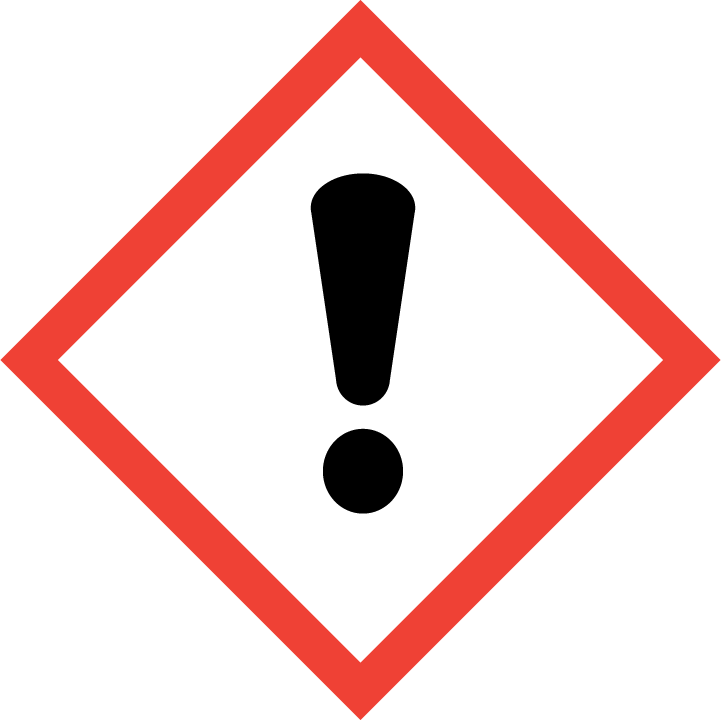
- Signal Words
- None
- Hazard Statement(s)
- H226: Flammable liquid and vapour
- H320: Causes eye irritation
- H227: Combustible liquid
- EUH202: Cyanoacrylate. Danger. Bonds skin and eyes in seconds. Keep out of the reach of children.
- Precautionary Statement(s)
- P210: Keep away from heat/sparks/open flames/hot surfaces. - No smoking.
- P260: Do not breathe dust/fume/gas/mist/vapours/spray.
- P264: Wash area thoroughly after handling.
- P271: Use only outdoors or in a well-ventilated area.
- P280: Wear protective gloves/protective clothing/eye protection/face protection.
- P340: IF INHALED: Remove victim to fresh air and keep at rest in a position comfortable for breathing.
- P338: IF IN EYES: Remove contact lenses, if present and easy to do. Continue rinsing.
- P337 ± P313: If eye irritation persists: Get medical advice/attention.
Primary route(s) of entry
Skin
Human Health
- Inhalation
- Do not breathe dust/fume/gas/mist/vapours/spray
- Ingestion
- No further data available
- Eyes
- IF IN EYES: Remove contact lenses, if present and easy to do. Continue rinsing.
- Skin
- Bonds skin and eyes in seconds. Keep out of the reach of children.
Environment
No further data available
3. Composition / Information on Ingredients
| Name | CAS No. | Content (w/w) | Classification |
|---|---|---|---|
| Ethyl 2-cyanoacrylate | 7085-85-0 | 30 - 60 | Not Available |
| Butyl cyanoacrylate | 6606-65-1 | 10 - 30 | Not Available |
4. First Aid Measures
- Ingestion
- Ensure breathing passages are not obstructed. The product w ill polymerise rapidly and bond to the mouth making it almost impossible to swallow. Saliva will separate any solidified product in several hours. Prevent the patient from swallowing any separated mass.
- Inhalation
- Move to fresh air. If not breathing, give artificial respiration. If breathing is difficult, give oxygen. If symptoms develop and persist, get medical attention.
- Skin Contact
- Do not pull bonded skin apart. Soak in w arm soapy water. Gently peel apart using a blunt instrument. If skin is burned due to the rapid generation of heat by a large drop, seek medical attention. If lips are bonded, apply warm water to the lips and encourage wetting and pressure from saliva in mouth. Peel or roll lips apart. Do not pull lips apart with direct opposing force.
- Eye Contact
- Immediately flush with plenty of water for at least 15 minutes. Get medical attention. If eyelids are bonded closed, release eyelashes with warm water by covering with a wet pad. Do not force eye open. Cyanoacrylate will bond to eye protein and will cause a lachrymatory effect which will help to debond the adhesive. Keep eye covered until debonding is complete, usually within 1-3 days. Medical attention should be sought in case solid particles of polymerised cyanoacrylate trapped behind the eyelid caused abrasive damage
- Other Information
- Surgery is not necessary to separate accidentally bonded tissues. Experience has show n that bonded tissues are best treated by passive, non-surgical first aid. If rapid curing has caused thermal bums they should be treated symptomatically after adhesive is removed.
5. Firefighting Measures
Suitable extinguishing equipment
- Fire
- Dry powder. foamCarbon dioxide.
- HAZCHEM
- No further data available
Special protective equipment and precautions for fire fighters
Fire fighters should wear positive pressure self-contained breathing apparatus (SCBA). Trace amounts of toxic and/or irritating fumes may be released and the use of breathing apparatus is recommended.
6. Accidental Release Measures
- Personal precautions, protective equipment and emergency procedures
- No further data available
- Environmental precautions
- Ventilate area. Do not allow product to enter sewer or waterways.
- Methods and materials for containment and clean up
- Do not use cloths for mopping up. Flood with water to complete polymerization and scrape off the floor. Cured material can be disposed of as non-hazardous waste. Refer to Section 8 "Exposure Controls / Personal Protection" prior to clean up.
7. Handling and Storage
- Precautions for safe handling
- Avoid contact with eyes, skin and clothing. Avoid breathing vapours or mists of this product. Wash thoroughly after handling. Avoid contact with fabric or paper goods. Contact with these materials may cause rapid polymerization which can generate smoke and strong irritating vapours, and cause thermal burns
- Conditions for safe storage
- For safe storage, store between 2 °C (35.6 °F) and 8 °C (46.4 °F)
8. Exposure Controls / Personal Protection
Exposure Standards
| Material | TWA ppm | TWA mg/m³ | STEL ppm | STEL mg/m³ |
|---|---|---|---|---|
| Ethyl 2-cyanoacrylate | 0.2 ppm | - | 1 ppm | |
| Butyl cyanoacrylate | 0.2 ppm | - |
- Engineering controls
- Use positive down-draft exhaust ventilation if general ventilation is insufficient to maintain vapour concentration below established exposure limits.
Personal protective equipment
- Eye and face protection
- Safety goggles or safety glasses with side shields. Full face protection should be used if the potential for splashing or spraying of product exists.
- Skin protection
- Use nitrile gloves and aprons as necessary to prevent contact. Do not use PVC, nylon or cotton.
- Body protection
- No further data available
- Respiratory protection
- Use NIOSH approved respirator if there is potential to exceed exposure limit(s)
9. Physical and Chemical Properties
General information
- Appearance
- Clear liquid
- Odour
- Sharp, irritating
- pH
- Not applicable
- Vapour Pressure
- < 0.2 mm hg
- Density
- Approximate 3
- Boiling Point
- > 149 °C (> 300.2 °F)
- Melting Point
- Not available.
- Solubility
- Polymerises in presence of water
- Specific Gravity of Density
- Not available.
- Flash Point
- 80 - 93 °C (176°F - 199.4 °F) Tagliabue closed cup
- Flammable (Explosive) Limits
- Not available
- Ignition Temperature
- 485 °C (905°F)
- Formula
- < 2 %; < 20 g/l (California SCAQMD Method 316B) (Estimated)
10. Stability and Reactivity
- Reactivity
- Not available
- Chemical stability
- Stable under recommended storage conditions.
- Possibility of hazardous reactions
- Not available
- Conditions to avoid
- Spontaneous polymerization.
- Incompatible materials
- Water, Amines, Alkalis, Alcohols.
11. Toxicological Information
- Acute effects
- Skin, Inhalation, Eyes
- Eye contact
- Irritating to eyes. Causes excessive tearing. Eyelids may bond.
- Skin contact
- Bonds skin in seconds. May cause skin irritation. Cyanoacrylates have been reported to cause allergic reaction but due to rapid polymerization at the skin surface, an allergic response is rare.
- Cyanoacrylates generate heat on solidification. In rare circumstances a large drop will burn the skin. Cured adhesive does not present a health hazard even if bonded to the skin.
- Ingestion
- Not expected to be harmful by ingestion. Rapidly polymerises (solidifies) and bonds in mouth. It is almost impossible to swallow.
- Inhalation
- Exposure to vapours above the established exposure limit results in respiratory irritation, which may lead to difficulty in breathing and tightness in the chest
- Toxicity and irritation
- Ethyl 2-cyanoacrylate :
- LD50s and LC50s: None
- Immediate and Delayed Health Effects: Irritant, Allergen, Respiratory
- Butyl cyanoacrylate :
- LD50s and LC50s: None
- Immediate and Delayed Health Effects: Irritant, Allergen, Respiratory
12. Ecological Information
- Ecotoxicity
- Not available
- Persistence and degradability
- Not available
- Bioaccumulative potential
- Not available
- Other adverse effects
- Not available
13. Disposal Considerations
General information
Dispose of according to Federal, State and local governmental regulations.
14. Transport Information
ADG label required
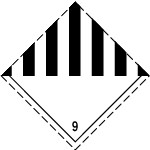
- HAZCHEM
- No further data available
- UN Number
- 3334
- Proper shipping name
- Aviation regulated liquid, n.o.s. (Cyanoacrylate ester)
- Transport hazard class
- 9
- Packing group
- III
- Additional information
- Primary packs containing less than 500mL are unregulated by this mode of transport and may be shipped unrestricted.
15. Regulatory Information
- Poisons Schedule Number
- Not available
- Other Information
- Not available
16. Other Information
- SDS preparation date
- 24 February 2026
- Comments
- This information is based on our present knowledge. However, this shall not constitute a guarantee for any specific product features and shall not establish a legally valid contractual relationship.This Safety Data Sheet (SDS) has been prepared in compliance with the Preparation of Safety Data Sheets for Hazardous Chemicals Code of Practice February 2016. It is the user's responsibility to determine the suitability of this information for adoption of necessary safety precautions. The information published in this SDS has been compiled from the publications listed in Section 16: to the best of our ability and knowledge these publications are considered accurate. We reserve the right to revise Safety Data Sheets as new information becomes available. Copies may be made for non-profit use.